Kr67

Kr67

A roguelike puzzle on a growing hex board. Place numbered hexes, stack them into heavier elements, and build a run that beats the target score, ante after ante.

Play free in your browser

No account, no download. Works offline once loaded, and installs to your home screen like an app.

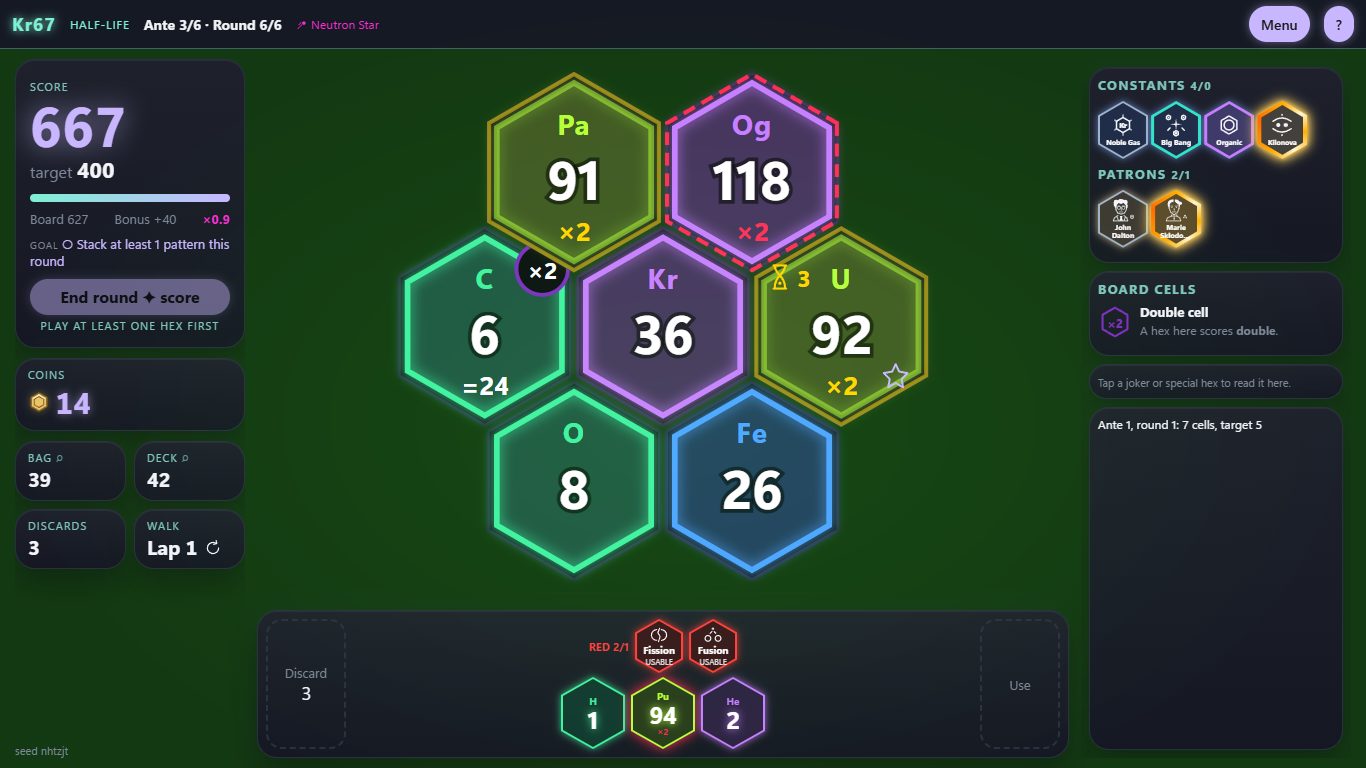
A Kr67 board mid-run: uranium, krypton, oganesson and iron hexes, jokers on the right, the hand below

How it plays

Place and stack

Hexes go onto the board along a clockwise walk out from the centre. You may skip one cell, but a skipped cell stays locked until the lap is done, so every placement is a small decision.

Lines, triangles, rhombi and flowers of hexes stack into one heavier hex. A hex's number is its atomic number: stack your way from hydrogen up through carbon, iron and krypton to the superheavies.
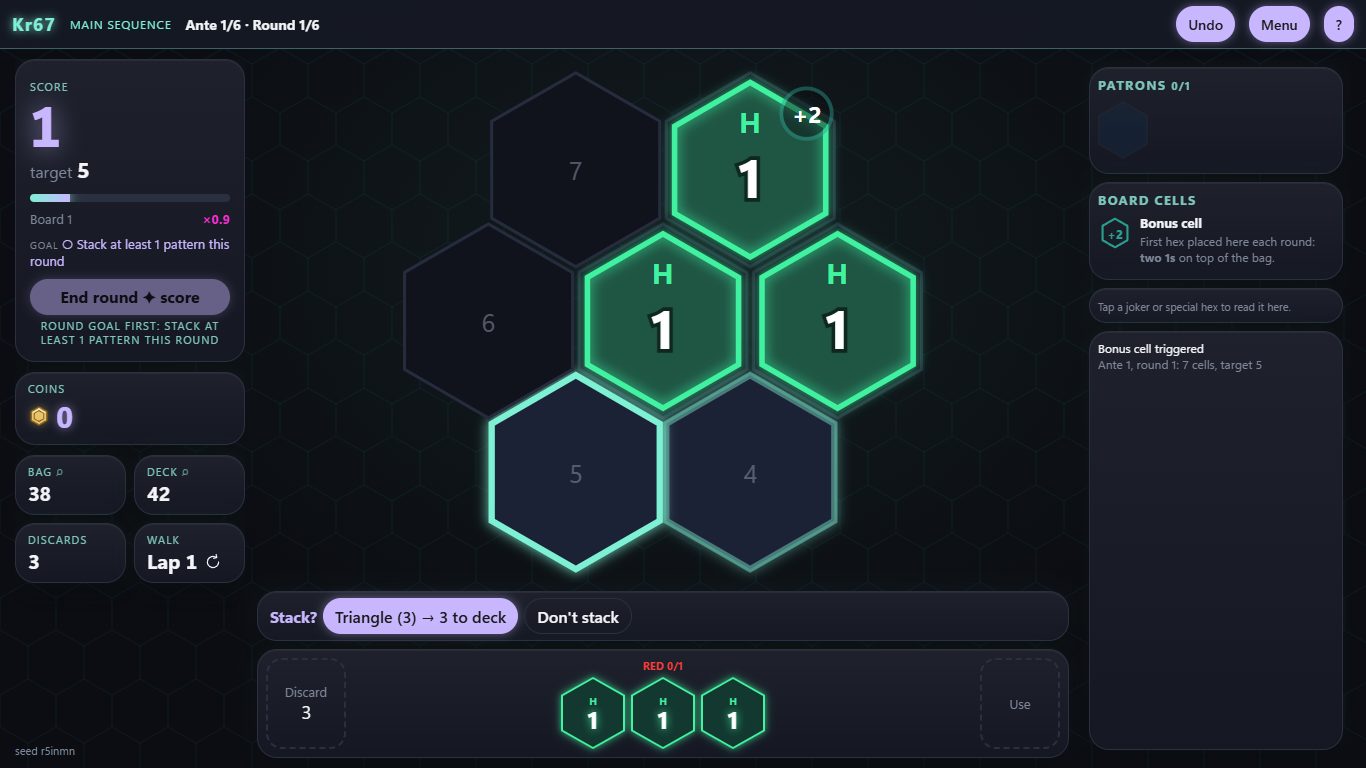
Three hydrogen hexes in a triangle on the first board, with the offer to stack them into a 3 (lithium)

Score the board

When you end the round, the board is counted from the centre outwards: each hex scores value × stability × its own bonus, and hexes closer to the centre are worth more. Radioactive elements score more, but they age and decay.

Reach the target to clear the round. Six rounds make an ante, and every ante the board grows by a ring.

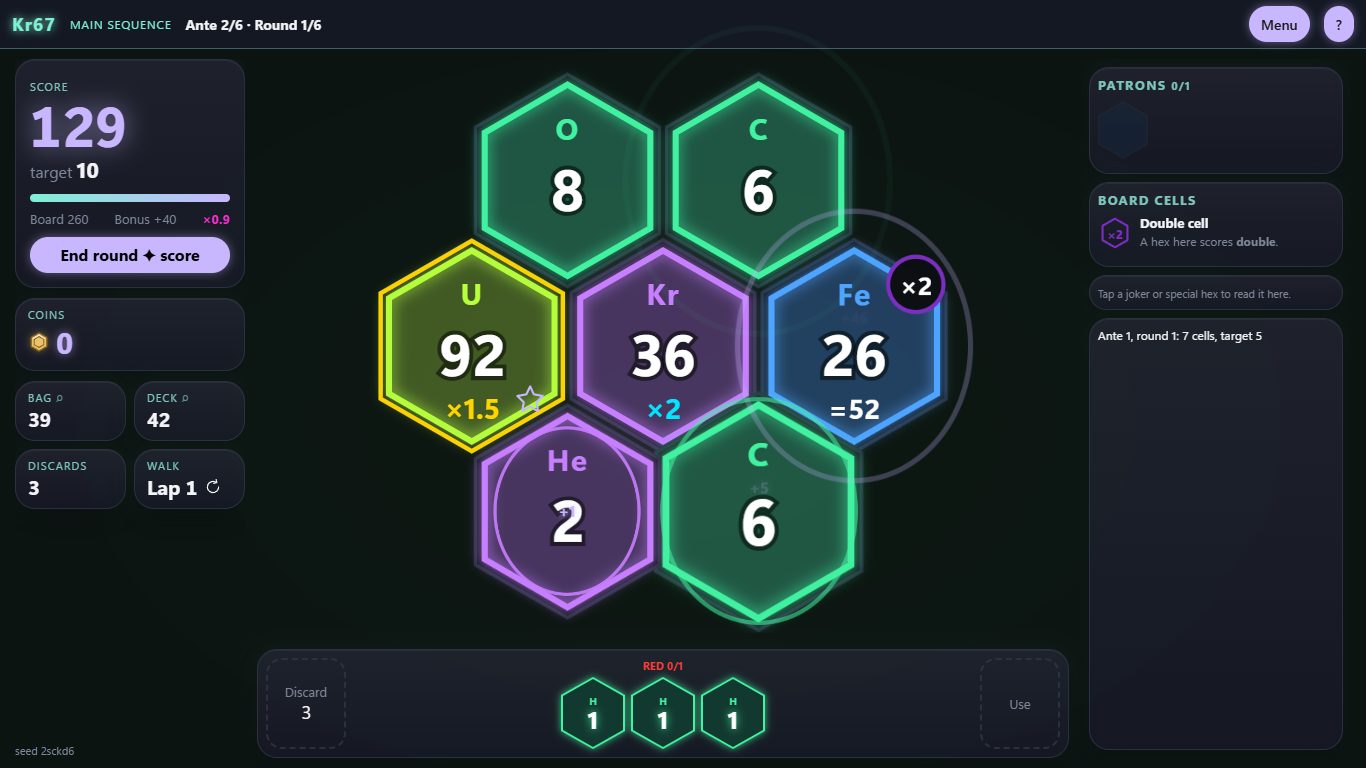
The end-of-round count: hexes light up one by one as they score

Build a run

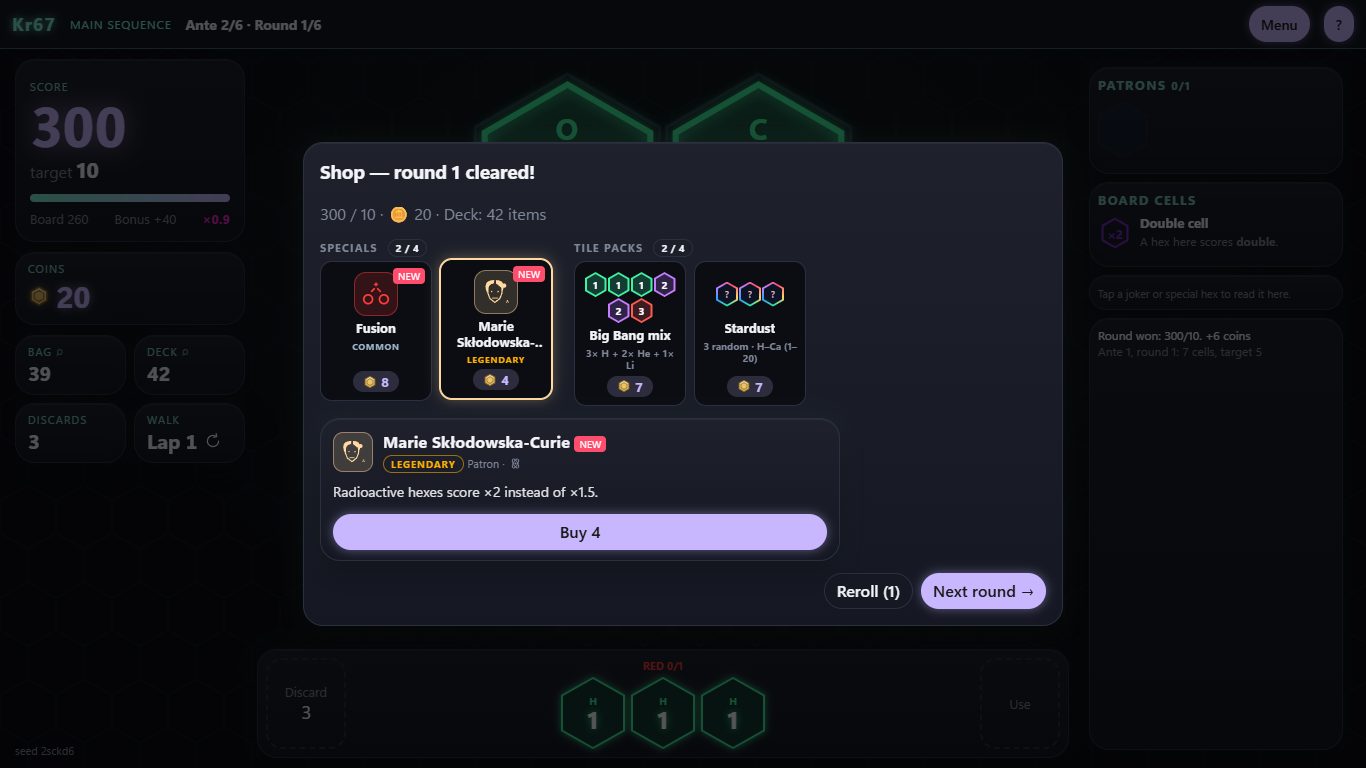
Between rounds the shop sells special hexes: constants and patrons that bend the rules, boosters, one-time catalysts, and red reactor hexes for fission and fusion. Tile packs refill your deck.

Every run is different: the bag you pick, the stellar stage, the special cells on each board and the jokers you find.

The shop between rounds: special hexes such as Fusion and a legendary patron, and tile packs

Fill the periodic table

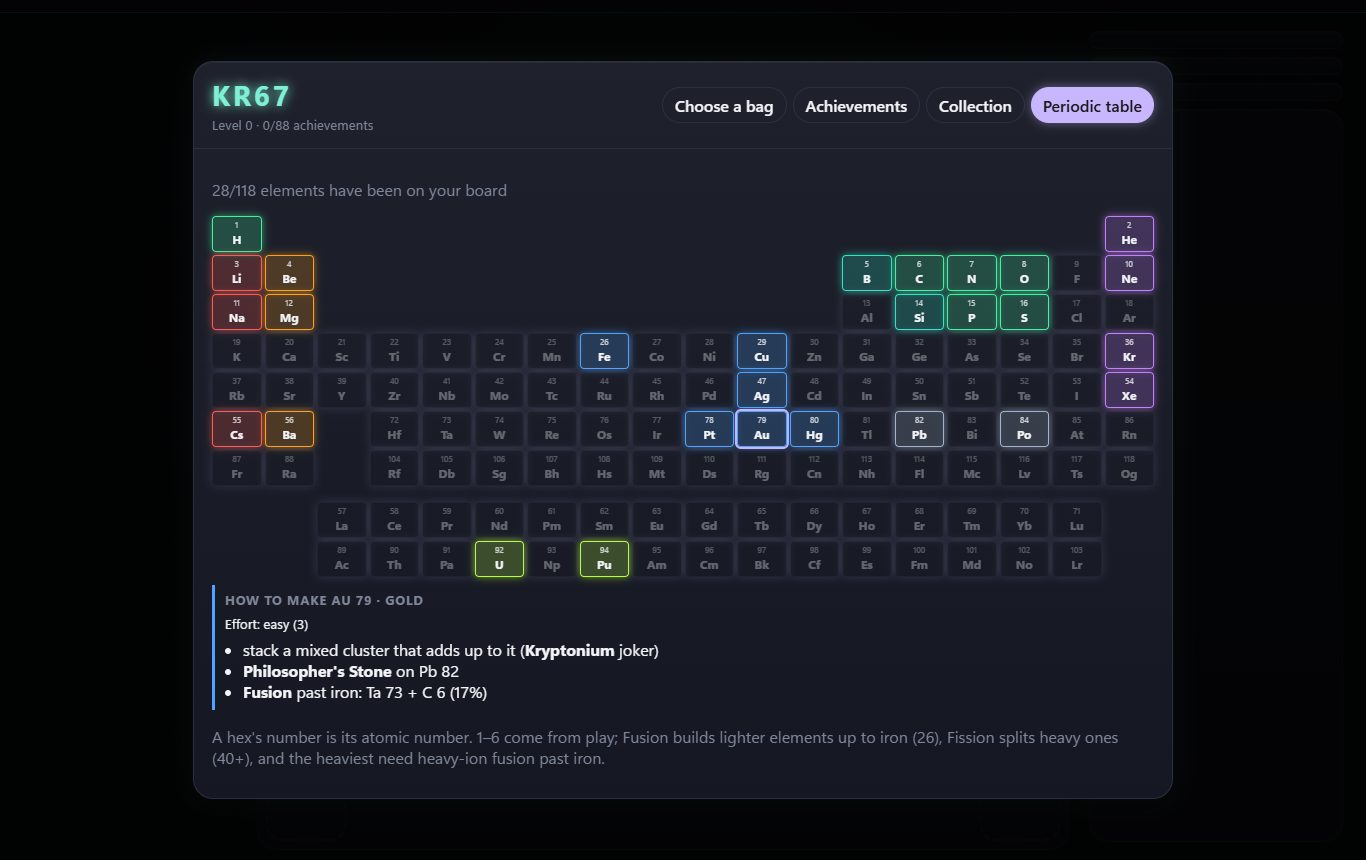
Every element that lands on your board lights up on the periodic table, with a recipe for how to make it. Achievements unlock new bags, stages and special hexes for your next runs.

The lab layer follows real nuclear data. The alchemy layer is pure game. Both stay simple enough to play with a pen and paper.

The periodic table screen: 28 elements found, with the recipe for gold open

Why krypton-67?

Krypton is element 36, and 36 is 6 × 6: the game's hexes grow in powers of six. Krypton-67 is a real isotope that lives about 7 milliseconds and decays by throwing out two protons at once, one of the rarest kinds of radioactive decay (Goigoux et al., Physical Review Letters 117, 162501, 2016).

Install it like an app

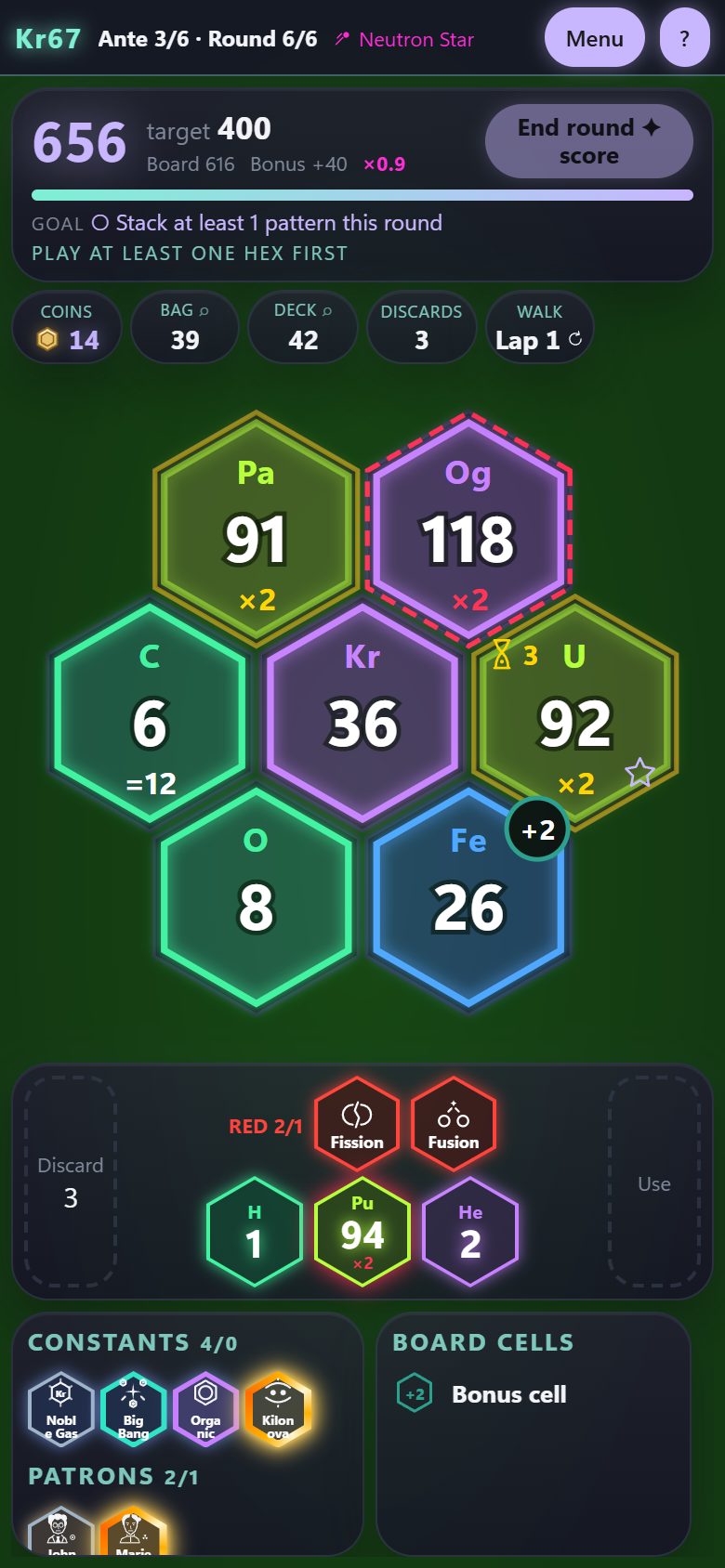
Kr67 on a phone: the score card, the board of elements, the hand and the jokers on one screen

The whole game fits one phone screen: score, board, hand and jokers.

Android

Open the game in Chrome, tap the ⋮ menu and choose Add to Home screen or Install app.

iPhone and iPad

Open the game in Safari, tap Share and choose Add to Home Screen.

Computer

In Chrome or Edge, click the install icon at the right end of the address bar.

Once installed, Kr67 starts without a connection. Updates arrive on their own the next time you're online.

Questions

Is it free?

Yes. The browser version is free to play. Later, you may be offered an optional ad after a lost run to continue it, only if you choose to watch one.

Do I need an account?

No. There are no accounts and no sign-in. The game runs entirely on your device.

Where is my progress saved?

In your browser on this device. Clearing the site data for the game erases it, so use Save progress to a file on the start screen now and then. Load progress from a file brings it back, on this or any other device.

Do you track me?

Only if you allow it. You may be asked once whether Kr67 can count anonymous usage statistics with Google Analytics (visits, runs started, rounds won). Nothing is loaded unless you choose Allow, and you can change your answer at any time on the game's start screen or with Cookie settings at the bottom of this page.

Does it work offline?

Yes. After the first visit the whole game is stored on your device, and it starts without a connection, especially when installed to your home screen.

Is the science real?

Partly, on purpose. Elements, isotopes, half-lives and decay modes come from the IAEA's nuclear data (see Credits), with simplifications marked. Stacking, flowers and powers of six are game mechanics and don't claim to be physics.

Will there be phone apps?

They're planned for Android and iOS. Until then, the browser version installs to your home screen and plays the same game.

Start a run